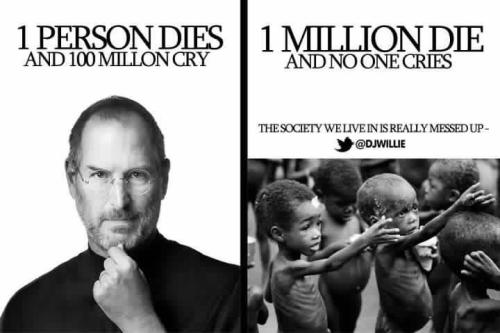
What is the first thing that one might think about when Apple Inc. is mentioned, or Africa? Steve Jobs and starving children might be possible answers.
When the world found out about the death of Steve Jobs, devastation sparked and many people were paying tribute to his brilliance and the significant impact that he made in technology. On the other hand, many people in western countries seem to be slightly oblivious about the issue of hunger in different parts of the globe. Western society these days focus on self-enhancement/improvement: suggesting that more is better. So the more things you have, the happier we’ll be. In reiteration, we have become more materialistic. This mentality can influence people to become ignorant in the sense that they care about things that directly impact them.
When I first saw this image I was moved by authenticity of the message that was displayed. As I mentioned earlier, many westerners care about things that directly impact them and they don’t care as much about global issues, which in this case is world hunger. When Jobs died many people grieved his loss, while thousands of people each day die from hunger around the globe. Don’t get me wrong, I admire his brilliance and the impact that he made in technology. However, I feel that many western people should care MORE about things that impact us globally instead of focusing their attention solely on ONE man.
Stuart Hall’s logic about the politics of representation emphasizes that in culture, we develop certain stereotypes for races and genders and we act toward an individual based on their subgroup. In this image, Steve Jobs basically fits the description for a white male. Educated, wealthy, etc. In addition, this can also relate to Dyer’s theory of “white culture” which suggests that it has become the norm of society and Jobs fits in this category. On the other hand, there is a negative stigma when it comes to evaluating Africa. Like I said earlier, many people generalize that Africa, as a whole is affected by hunger. The truth is, not EVERYONE in Africa is affected by hunger. It’s just more common, considering that there is less government assistance, such as food stamps and wars have significantly affected many countries. I’ve been to three African countries and hunger a big issue, but I think that the media exaggerates the depth of the situation and provides biased information, implementing a certain stereotype. In relation to the politics of representation, African people are associated with negative things and their positive achievements aren’t as recognized. The perpetuation of this streotype ignites ignorance.

I had a discussion about this photo with my roomate before looking at this photo, and we both seemed to agree that it wasn't necessarily a lack of knowing that African children are starving, it is a lack of caring. Steve Jobs did more for them than African children, and therefore his death is more significant to Americans, which you touched on. The lack of care, quite frankly, seems worse than ignorance. Almost every image of Africans in the US is of starvation and poverty, a dismal representation that still doesn't seem to effect Americans. It makes me wonder what would.
ReplyDeleteThere are many children starving in poor areas. I think all countries must take responsibility to help them. All children have the rights to live happily. I really want to find some ways to help them.
ReplyDeleteThis goes along the lines of Stalin's "One death is a tragedy; one million is a statistic" quote. I agree with Sharon though - it's more because many people in the world just don't heed the fact that so many people die in the world all the time.
ReplyDeleteIt also speaks to the attention today's culture devotes to celebrities and famous personalities, and how more of that kind of attention should maybe be turned toward larger causes